The Gross Clinic by Thomas Eakins
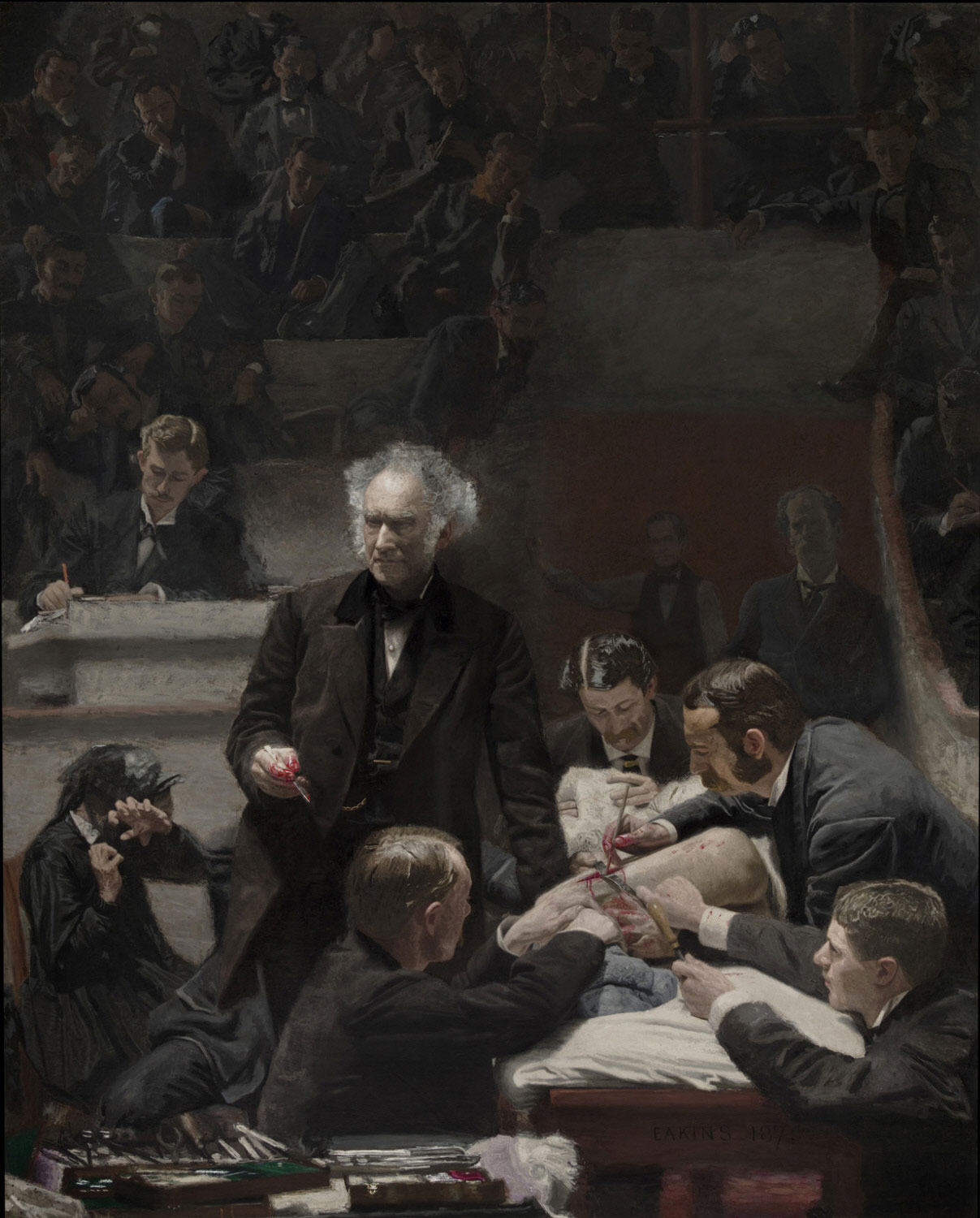
Choosing the city’s world-famous surgeon and teacher Dr. Samuel Gross as his subject, Eakins sets the scene in Jefferson Medical College’s surgical amphitheater. Dr. Gross is shown leading a clinic of five doctors operating on the left thigh of a patient. At the same time Gross is demonstrating to students the relatively new surgical procedure he had developed to treat bone infections. In contrast to the recoiling woman to the left—traditionally identified as the patient’s mother—Gross embodies the confidence that comes from knowledge and experience. Casting himself as a witness, Eakins can be seen seated to the right of the tunnel railing, sketching or writing.
Click to Learn More
In The Gross Clinic Thomas Eakins shows Dr. Samuel D. Gross operating on a patient. Eakins paints the people in the painting in a realistic way, using dark colors to represent the gloomy indoor space. In the painting, Gross shows his students a new procedure for curing bone infections that he developed. On the left side of the painting, the patient’s mother is shown looking away from the bloody scene, whereas Gross stands strong with “the confidence that comes from knowledge and experience” (Label for The Gross Clinic). Next to Gross his students operate on the patient. In this painting Gross is putting his knowledge about surgery to good use in working to not only cure his patient but also teach his students. The Gross Clinic especially highlights the way in which Gross is able to apply his knowledge in using his new procedure on the patient. In addition, Gross is passing on his knowledge to students who could apply it in the future. Knowledge by itself is not valuable or useful to society; only when applied does it becomes useful.
Last year in Pre Calc. Honors my teacher, Mr. Pline, made “real world problem solving” problems for my class in which I had to apply my knowledge from class in problems he created. The problem I remember the most clearly was in May when he made a giant parabolic hill out of plywood, and the goal was to calculate what angle and position we had to place a laser on the hill in order to hit a paper zombie on the other side. In this problem, my group had to apply the introductory calculus we had recently learned in order to find a line tangent to the hill passing through the zombie. Then we could place the laser at the point where the line touches the hill and use trigonometry to find the angle. My group succeeded in hitting the zombie, and I had a great experience being able to apply my knowledge in new ways. What I had learned in class did not do much of anything for me until I was able to apply it in a problem.
I find the most interesting part of The Gross Clinic to be how Eakins contrasts the color of the blood with the rest of the painting. The majority of the colors used tend to be dark and gloomy with many greys and browns, but the blood on Gross’s and the students’ hands and the patient’s leg is a bright red. This stood out to me as it emphasizes the quantity of blood in the painting. However, Gross and his students are able to work past the blood and focus on the task at hand, showing how committed they are to their work. The blood would nauseate most people, who would not be able to make any progress, but Eakins shows just how committed he and his students are to doing their work.