Autothermal Pyrolysis by Kimberly Moss
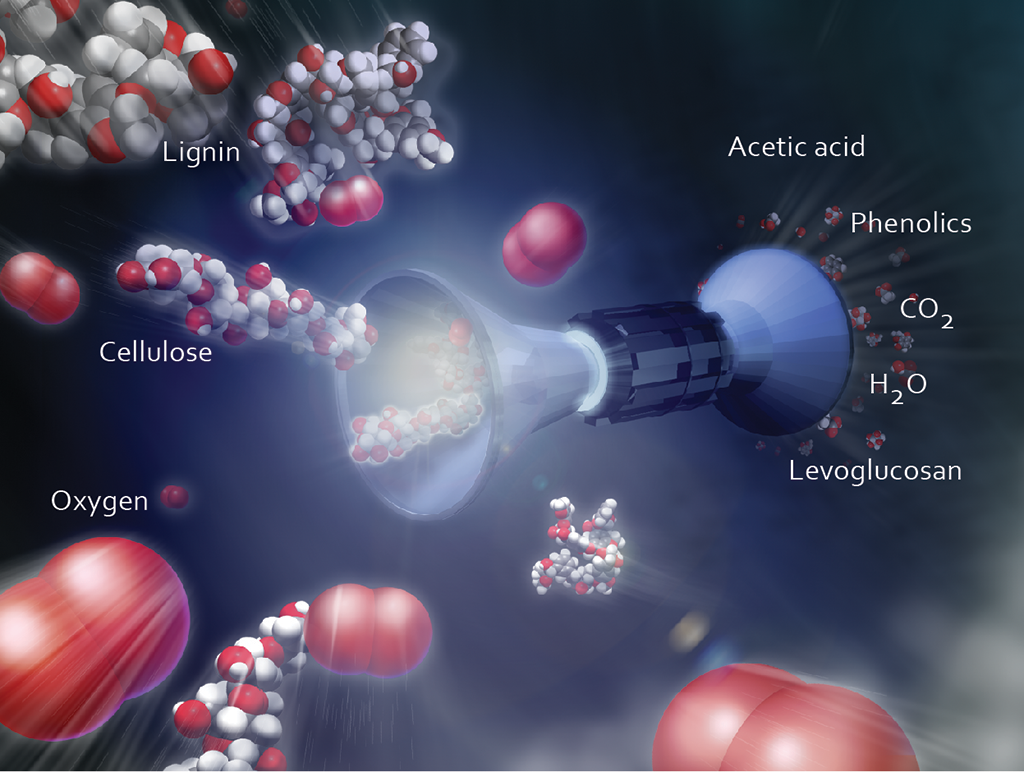
This is a graphical abstract describing the research of Dr. Robert Brown, Director of the Bioeconomy Institute, Pyrolysis Process Development Unit (PPDU) located at the BioCentury Research Farm at Iowa State University. The visual abstract summarizes authothermal pyrolysis, which is a mechanism used to intensify and increase the rate in which biomass can be processed for energy in a given-size reactor. Just as wood is converted to charcoal through fire, domestic biomass, like leaves and husks, can be converted to products used to create low-carbon biofuels. The key here is the addition of oxygen with the biomass components, such as lignin and cellulose shown on the left side, entering the reactor unit.
Autothermal Pyrolysis by Kimberly Moss shows the process in which biomass such as cellulose and lignin combine with oxygen to convert into usable biofuels. Labeled models of each reactant and product speed into and out of the reactor, showing the fast rate of the reaction. The reactants are shown in the foreground as they are the unique part of this type of reaction. Moss created this image to help teach people about the process of autothermal pyrolysis. Everyone is a different type of learner, such as auditory, visual, or kinesthetic, and gains knowledge about concepts in different ways. Because of this, each different teaching method helps different people learn. In this image Moss especially helps visual learners as she visually shows the reaction of autothermal pyrolysis. That way Moss provides another way besides simply reading to gain knowledge about this reaction.
The most important reactant in the process of autothermal pyrolysis is oxygen. This element makes the reaction faster and more efficient. I found it especially interesting how Moss emphasizes oxygen’s importance by making it the only element in the image shown in color with all other elements colored on the grayscale. Even carbon, which in almost all cases is black, is shown in white. Larger molecules and oxygen gas both have oxygen shown in its standard color, red, which draws attention to all of the substances that include oxygen. Using this coloring scheme allows Moss to better show oxygen’s essential role in the reaction.
I feel that I am a primarily visual learner. In most science classes I learn better by visually seeing diagrams or pictures of reactions or processes. Often I cannot simply gain knowledge from reading a text. I noticed this especially last year in Biology as I had a lot of trouble understanding when we first read about the processes of transcription and translation. However, when Mr. Carrier then drew a diagram of how mRNA copies DNA, and tRNA and rRNA convert it into proteins, I was able to fully understand it and gain that knowledge. Throughout school in classes like chemistry, English, and history, I have continued to notice how I gain knowledge more easily visually than using other methods such as reading or listening.