School of Athens by Raffaello Sanzio da Urbino*
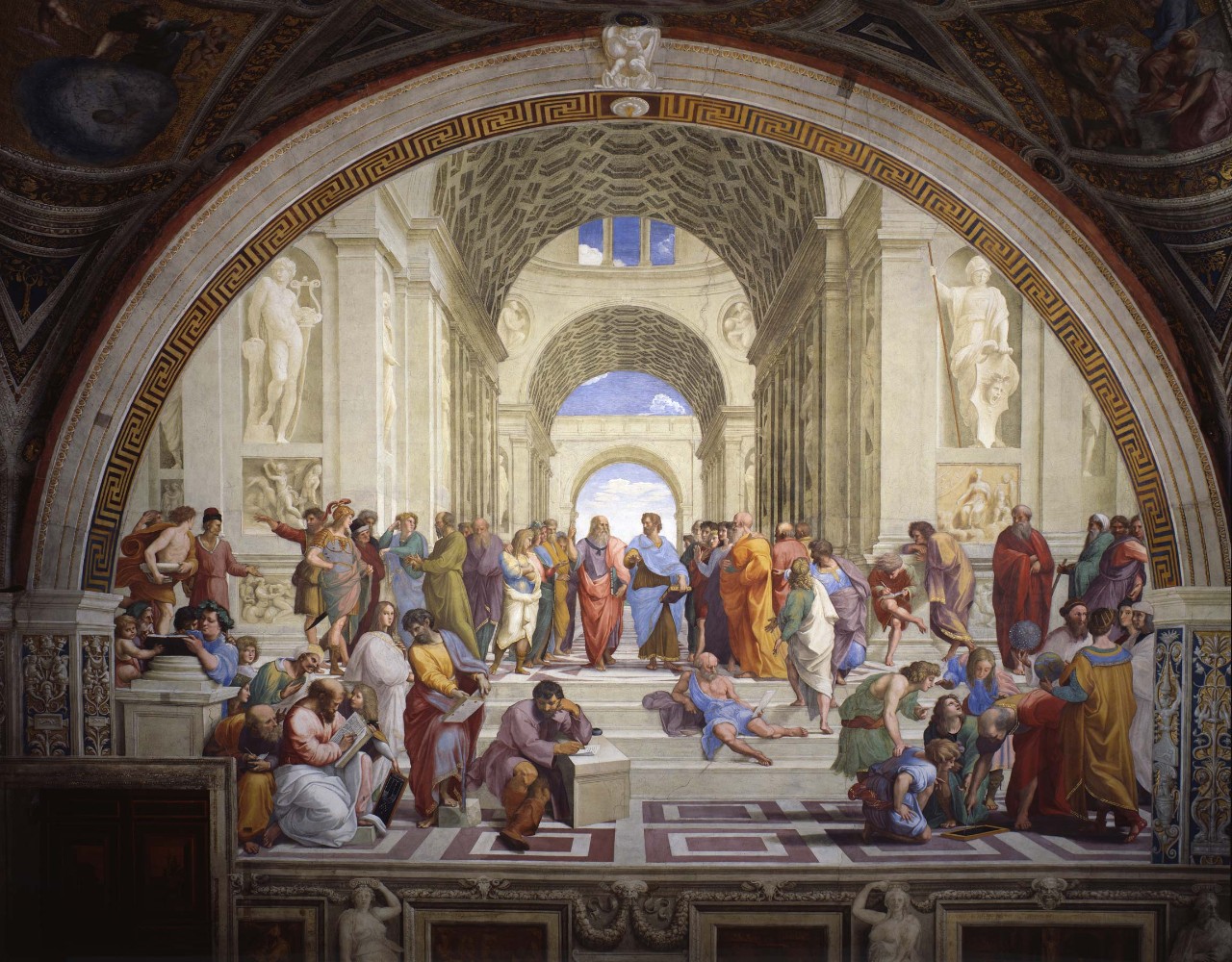
The most famous philosophers of ancient times move within an imposing Renaissance architecture which is inspired by Bramante's project for the renewal of the early Christian basilica of St Peter. Some of these are easily recognizable. In the centre Plato points upwards with a finger and holds his book Timeus in his hand, flanked by Aristotle with Ethics; Pythagoras is shown in the foreground intent on explaining the diatesseron. Diogenes is lying on the stairs with a dish, while the pessimist philosopher, Heracleitus, a portrait of Michelangelo, is leaning against a block of marble, writing on a sheet of paper. Michelangelo was in those years executing the paintings in the nearby Sistine Chapel. On the right we see Euclid, who is teaching geometry to his pupils, Zoroaster holding the heavenly sphere and Ptolemy holding the earthly sphere. The personage on the extreme right with the black beret is a self-portrait of Raphael.
School of Athens by Raffaello Sanzio da Urbino, more commonly known as Raphael, shows many great philosophers throughout history gathered together in a Renaissance building. Raphael shows Plato pointing upward in the middle of the painting toward his separate World of Forms and Ideas. Next to him Aristotle has his palm down towards the ground as he believed the Forms were part of the physical world. Other philosophers in the painting include Diogenes and Heracleitus. Along with philosophers, Raphael included mathematicians such as Pythagoras, Euclid, and Ptolemy. School of Athens shows all of these great philosophers and scientists together in the same room, representing how they influenced each other. Each of them gave new knowledge and ideas to society and built off of each other’s contributions. Throughout history all of these great people had new discoveries, such as the Pythagorean theorem or Euclidean geometry. Each of them gave humanity knowledge that it can build off of further, allowing for great progress in the fields of math, astronomy, medicine, and other sciences.
I found the most compelling part of this painting to be some of the contrasting ideas shown. In the middle of the painting, Raphael contrasts Plato and Aristotle’s beliefs about the true nature of the world, with Plato pointing toward the sky and Aristotle pointing toward the ground. Another contrast is on the right side of the painting where Zarathustra holds a globe covered in stars representing the divine and the heavens, contrasted with Ptolemy holding a globe of the Earth representing his geocentric model. These contrasts show how different ideas conflicted throughout history and how they had to compete for accuracy to be widely accepted.
My father is also a philosopher, and although the world will probably not remember him as well as the greats shown in School of Athens, he has made contributions of knowledge to society as well. He studies the impact of values in science, which can affect how scientists perceive and analyze the results of studies and experiments. He has also written two books that can continue to add knowledge to society after he is gone. Just as Raphael’s philosophers and scientists had a profound impact on society through their schools, teachings, and written works, my dad is having an impact on society, albeit not quite as large.